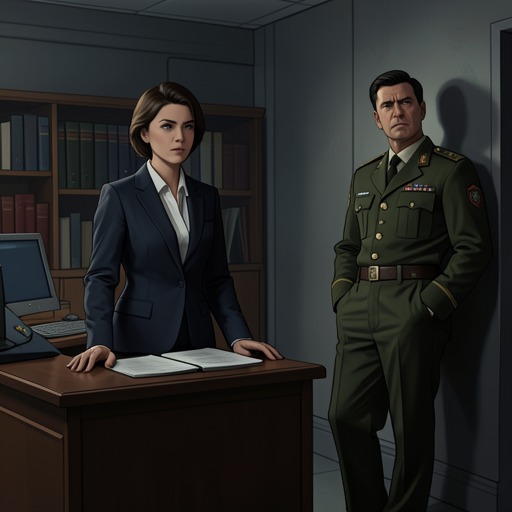
Thobela Mpayipheli and the intelligence chief: old friendship and lingering guilt
Heart of the HunterThe relationship between The Director and Thobela Mpayipheli is an old friendship shadowed by institutional neglect. A faded photograph from Dar es Salaam in 1984 establishes their personal connection, while The Director’s later confession explains how he failed to help Thobela when the world that had trained and employed him disappeared. His recollection does more than supply Thobela’s hidden history: it makes the intelligence chief confront his own part in the circumstances that shaped Thobela’s life, and turns Thobela’s restraint during the present manhunt into evidence that he may have changed.
Friendship and the 1984 photograph
The Director discloses the relationship to Janina Mentz while the two are discussing the need for greater control. He opens a desk drawer and takes out a dog-eared colour photograph, handling it as a keepsake rather than a file. In the image, The Director is young, with his arm around a tall, broad-shouldered Black youth; a military vehicle stands behind them. He identifies the setting as Dar es Salaam in 1984 and the young man as Thobela Mpayipheli, once his friend. The intimacy of the pose gives material form to a bond that official records cannot explain.
The photograph also unsettles Janina’s understanding of The Director’s conduct. She infers that his personal connection explains why he allowed the Reaction Unit to come. Her inference follows his disclosure, but he does not directly confirm that this was his reason. Instead, his attention turns to the past and to the history that made Thobela both exceptionally capable and difficult to trace.
Thobela’s formation and hidden history
The Director describes Thobela as a young recruit singled out early for unusual ability. Thobela was only seventeen when he enlisted. While other recruits received general infantry training in Tanzania and Angola, he was sent with an elite group to the Soviet Union and East Germany. The KGB kept The Director’s side informed about his training before the Germans took him into their hands. This history helps explain why ordinary records offered so little guidance about Thobela: his development took place within elite, secretive channels rather than a conventional military career.
The Director remembers Thobela as dedicated, intelligent, physically strong, mentally tough, fast, and a skilled marksman. The recollection carries admiration, but it is not uncomplicated praise. The same qualities that made Thobela valuable to his former handlers made him dangerous, and The Director calls him ruthless. The photograph’s image of a friend and the account of a trained operative therefore sit uneasily together: personal affection has survived alongside a clear-eyed knowledge of what Thobela can do.
Abandonment after the Cold War
The Director’s account changes from recollection to confession when he explains what happened after the fall of the Berlin Wall. Thobela’s German handlers vanished, his pay stopped, and the West’s access to the East German Ministry for State Security files left him expecting to be hunted. The old system had made him useful but offered no secure place for him once it collapsed. The Director recalls that the London office had been staffed by new personnel who did not know Thobela and did not want to know him.
Thobela eventually returned home and approached The Director for work. The Director says that he promised to help, but the elections and the arrival of a new government diverted his attention. He simply forgot. The admission gives the friendship a painful asymmetry: Thobela came to someone he trusted, and that person failed to keep his promise at the moment when Thobela had lost his livelihood and protection. The Director does not present this as an unavoidable bureaucratic accident. He accepts responsibility, saying it was his fault that Thobela found another livelihood.
Guilt, restraint, and the hope of reaching him
The Director’s guilt is sharpened by his comparison between the Thobela he remembers and the man now being pursued. He tells Janina that if Thobela were still Umzingeli, there would be at least four bodies to explain. The number makes the difference concrete: in the Director’s judgment, Thobela had the capacity to answer the present danger with lethal force, yet has spared the people who might otherwise have died. The change does not erase his history, but it interrupts the expectation that his former identity dictates every action.
The Director treats that restraint as a possible opening. If Janina can determine why Thobela spared them, she may have a chance of bringing him in. His advice joins professional calculation to personal knowledge: he understands the threat Thobela represents, but he also remembers the friend in the photograph and believes the man before them is not simply the operative he once knew. The possibility of change matters because The Director’s own failure helped leave Thobela without work or support; his attempt to interpret Thobela’s present conduct comes with the burden of that history.
A relationship framed by debts and choices
Thobela’s own understanding of obligation offers a revealing contrast to The Director’s admission. When Miriam Nzululwazi reminds him that he had said he could no longer live his former life, Thobela agrees that refusing the commission is a choice and insists that he must choose what makes him an honourable man. He regards his debt to Johnny Kleintjes as a debt of honour, alongside the duties of caring for Miriam and Pakamile and living lawfully. His reasoning shows that obligation, for him, is not merely a tie to the past: it can demand action, but it can also be weighed against the life he is trying to build.
The Director’s failure and Thobela’s sense of debt illuminate two different forms of responsibility. The Director’s promise to help was not kept; Thobela, by contrast, insists that honour requires him to repay what he owes even when he knows he can refuse. His hope of beginning again with Miriam and Pakamile at the Cala River stands beside the pull of that older obligation. In this light, The Director’s belief that Thobela has changed is not a claim that their past can be undone. It is recognition that a person’s former role need not settle every choice that follows—and that the friend who once failed him may still be able to understand the difference.